
How Can the Torah "Speak Lashon Hara"?
Credit for this exchange must be given to Ayala, age 9, from Cleveland, OH.
Q. I am looking for an answer to a sharp question my daughter asked this past Shabbos. She is a fierce thinker and doesn’t take roundabout answers, and can sniff any hypocrisy from a mile away.
My daughter asked, “With lashon hara being such a bad aveirah, how can the Torah describe bad things tzaddikim did?” Yikes. Parental clueless moment.
Of course we know there is the concept of l’toeles that allows sharing unfavorable information in certain circumstances, and that’s the basic answer people gave me. However, we know in a comparable contemporary situation, a teacher is not allowed to use a specific student as an example of what not to do, so the toeles answer is not in line with halacha.
I also don’t believe there is any concept that a person can give permission for someone else to use them as an example l’toeles. Maybe if the incident is already universally known, but I would have to look into it.
I noticed you wrote about a similar topic on the Jew in the City website regarding bad things tzaddikim have done, so I figured I would check with you. Do you have any answer?
A. Thanks for your very intriguing question. I’m answering it now “al regel achas” because I’m out all next week and I didn’t want to leave it until the end of the month.
We speak of emulating God – “as He is merciful, so should you be merciful,” etc. But doesn’t God cause thousands of people to die every day? Doesn’t He impoverish people? Doesn’t He make fire on Shabbos? Clearly, we’re not allowed to do any of those things!
The reality is that different rules apply to us and to God. He has a universe to run, but we have a universe to live in. He made our rules, but is not bound by them, like a parent who sets a bedtime for a child or a curfew for a teen. So, technically speaking, God can “speak lashon hara” if He wants.
Of course, God is not malicious and He wouldn’t “speak lashon hara” just because He’s a gossip or needs to run other people down. But He would share negative information l’toeles.
We can also share negative information l’toeles, but we have to make all sorts of cheshbonos in order to ensure that it’s accurate, that our intentions are pure, that there’s no other way to accomplish the goal, etc. None of these concerns applies to Hashem, who is all wise and all good. He knows when the objectively good thing is to share negative information, even about tzaddikim.
Consider members of Hatzalah: Do they violate Shabbos every week? Of course not. What they’re doing is in compliance with the laws of Shabbos, even if their circumstances give them different parameters. Just like what may look like chillul Shabbos isn’t, negative speech in the Torah might look like lashon hara, but it isn’t. It might be lashon hara if you or I were to say it about a friend, but it’s not lashon hara if Hashem chooses to share it, even about tzaddikim, because He has completely different parameters.
I hope this helps!
Q. Thank you for the thoroughly explained answer. I’m digesting it. Conceptually it has merit, but something about it feels odd.
The first problem that comes to mind is we see the same telling of improper behavior in the Gemara, which your article gave numerous examples. So it’s not just Hashem and in Tanach. It seems to even apply to humans, but the question is how can it?
Secondly, all of the things Hashem does that we can’t are done in order to run the world as it needs to be. If not, we would go back to tohu vavohu. However, is the specific recording of mistakes by tzaddikim in the Torah the only way to impart upon us the lessons we learn from them?
Granted, if some crazy apikores decided to rewrite the Torah in a manner that follows hilchos shmiras halashon as it applied to us, it would have lots of holes in how we became a nation and at times not make a whole lot of sense.
The second problem I can probably ignore, but the first one is hard to discount.
A. Can you please direct me to the article in question so I can see to what you refer?
Q. https://jewinthecity.com/2019/11/can-a-tzaddik-make-a-mistake/
A. Ah. So you are asking how the Gemara can report such shortcomings on the part of our Gedolim, correct? I have several hypotheses.
First, how can we talk about what, say, Bernie Madoff did? Isn’t that lashon hara? The reality is that there’s a point – that I can’t define – at which lashon hara becomes common knowledge. If you want to talk about Bugsy Siegel or Meyer Lansky, you need not be concerned that it’s lashon hara.
Second, think about the examples of “misdeeds” attributed to Gedolim. They don’t involve them, say, cheating on their taxes and then bragging about how they got away with it. Rather, such stories illustrate how great they were, even if they weren’t perfect.
Finally, consider the famous story of Rabbi Yisrael Salanter during the 1848 cholera epidemic in Vilna: he got up in shul and ate publicly on Yom Kippur in order to demonstrate the steps we must take in order to preserve life. That’s a case of him demonstrating “I know the halacha better than you.” Similarly, if Chazal tell a story publicly in the Gemara, I think we can be pretty confident that they know what the acceptable parameters are.
So, those are my three hypotheses (which are not mutually exclusive): the information is public, it’s ultimately praise, and emunas chachamim that Chazal know the halacha better than I do.
I hope this helps!
Q. I appreciate you looking into it. I hear what you’re saying. I guess it’s different than how we normally view things, so it’s a bit of a paradigm shift that feels a little uneasy. I would say I’m apprehensive about it, as opposed to skeptical. I need to look at those gemaras and maybe some others, and see how they fit with what you are saying. I trust you will be proven correct.
POSTSCRIPT: I addressed a similar question a few years ago, and at that time I made a point that didn’t come up here, but probably would have had the exchange continued, to wit: sometimes the Torah does conceal people’s names! The Torah never says that Tzelofchad was the person gathering sticks in the midbar. Rabbi Akiva draws this conclusion in the Talmud and Rav Yehuda ben Beseira chides him that, even if Rabbi Akiva is correct, the Torah chose to withhold this information. Similarly, the name of the blasphemer is withheld by the Chumash. And then there’s the case of “Ploni Almoni” in the Book of Ruth, literally “John Doe.” (The pseudonym also appears in Shmuel Alef 21:3.) Here’s the mindblower: Sefer Shoftim discusses a Levite who gets a job as a priest to an idol. His name? Yehonasan ben Gershom ben Menashe (18:30). I’ll give it to you in Hebrew, so my point will be easier to see: יהוֹנָתָן בֶּן-גֵּרְשֹׁם בֶּן-מְנַשֶּׁה In the text, the letter nun is in superscript. If we ignore what appears as a tiny, floating letter, it says “Yehonasan ben Gershom ben Moshe” – in other words, the son of Moshe’s son Gershom! The mefarshim explain that the Navi inserted the partial letter nun in order to obscure Moshe’s name in this context.
So we see that the Torah does conceal names when sharing them would not be l’toeles. Aharon made the eigel hazahav? There’s a lot to learn from that. But there’s nothing to learn from the name of the blasphemer, so the Torah leaves that out. (Though there is what to learn from his lineage, so the Torah includes that information.) Similarly, there’s a lot we can learn from the incident in which Moshe got angry and struck the rock. There’s not a lot of toeles in telling us that his grandson went “off the derech,” so the Navi obscures whether or not this is in fact the case. So even Hashem doesn’t recount misdeeds without adhering to certain (self-imposed) boundaries!
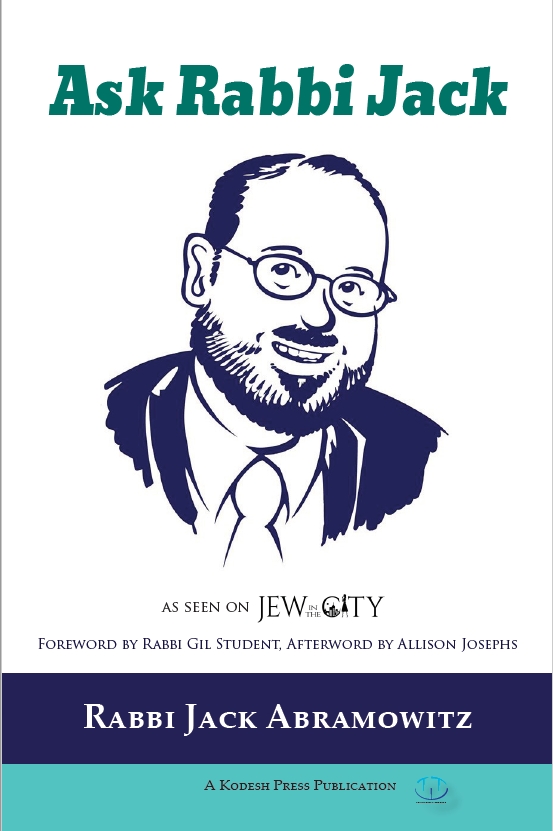
Rabbi Jack's book Ask Rabbi Jack is available from Kodesh Press and on Amazon.com.